FOUR BOOKS. ONE JOURNEY.
ONE DESTINATION: LIVING RESTORED
Four books. Four perspectives. One transformative journey toward becoming whole.
THE TOTAL MAN – Building a Man’s Internal Moral Character
The journey begins with character. The Total Man challenges men to examine who they are on the inside and build a life grounded in integrity of character, responsibility, purpose, authority, boundaries, and love.
LEFT ADRIFT AND ALONE – A Conversation with the Little Boy Within
The journey turns inward. Left Adrift and Alone is a hybrid memoir and guide that confronts the experiences, wounds, absence, and unanswered questions that can shape who we become. It is a conversation between the man today and the boy he once was.
THE EIGHT MOVEMENTS OF RESTORATION – A Journey From Wounded to Restored
The journey moves toward restoration. The Eight Movements of Restoration provides a spiritual blueprint for rebuilding from the inside out through eight movements:
Read. Research. Reckon. Remove. Repent. Restore. Resist. Redeem.
LIVING RESTORED – The Destination
The journey culminates in Living Restored.
Restoration is not simply something we experience. It is something we learn to live.
Living Restored brings the journey full circle, challenging us to take what we have learned about character, confronted in our story, and experienced through restoration, and live it out intentionally.
Because the goal was never simply to understand the wound. The goal was never simply to survive the past. The goal was never simply to be restored.
The goal is to live restored.
Living Restored Book Series Overview
The Living Restored Series is a comprehensive four-guide journey designed to foster an atmosphere of transformation for men. Starting with the development of moral character, transitioning to confronting past wounds, moving through active restoration, and finally attaining a life of purpose, each volume builds the foundation for the next. The series offers four distinct guides within a single, unified journey toward one specific destination: Living Restored. Through this intentional progression, men are equipped to navigate their unique stories and emerge with a renewed sense of identity and spiritual wholeness.
Four guides. One journey. One destination: Living Restored.
.jpg)
The Total Man
Building a Man's Internal Moral Character
The Total Man is a call to men to look beyond appearances, accomplishments, titles, and outward behavior and examine the character being built within.
At its core, this book is about integrity of character.
A man's character is revealed not simply by what he says, what he accomplishes, or how others see him, but by who he is when no one is watching. It is found in the decisions he makes, the standards he lives by, the responsibilities he accepts, the boundaries he maintains, and the values he refuses to compromise.
The Total Man challenges men to understand that becoming a better man begins on the inside. Before a man can effectively lead others, he must learn to govern himself. Before he can be trusted with greater responsibility, he must develop the character necessary to carry it.
The book provides a framework for building that internal character through seven foundational values:
Surrender. Order. Purpose. Boundaries. Authority. Responsibility. Love.
These values are not simply principles to understand. They are disciplines that must become part of a man's internal moral framework and ultimately be reflected in how he lives.
INTEGRITY OF CHARACTER
Integrity is more than honesty. It is the alignment between what a man believes, what he says, and how he lives.
The Total Man challenges men to examine the gaps between their values and their behavior and to take responsibility for closing those gaps.
It asks difficult but necessary questions:
Who are you when no one is watching?
Can your character support the responsibility you desire?
Do your actions agree with the man you say you are?
What values are you unwilling to compromise?
Can the people closest to you trust the man behind the image?
The goal is not to create a perfect man. It is to develop a man whose internal character is strong enough to govern his decisions, relationships, leadership, and influence.
BUILDING FROM THE INSIDE OUT
The Total Man teaches that lasting transformation begins internally.
A man can change his appearance without changing his character. He can change his position without changing his principles. He can gain influence without developing integrity.
But eventually, what is inside will determine what comes out.
This book therefore focuses on the work that cannot always be seen: developing self-discipline, accepting responsibility, establishing boundaries, understanding authority, discovering purpose, practicing love, and learning to surrender what must be surrendered.
The objective is to build a man whose character can carry his calling.
THE SEVEN VALUES OF THE TOTAL MAN
Surrender teaches a man that strength is not found in controlling everything, but in knowing what must be surrendered and submitting himself to a higher standard.
Order teaches discipline, structure, and the importance of bringing the internal and external areas of life into proper alignment.
Purpose challenges a man to understand why he exists and to live intentionally rather than simply reacting to circumstances.
Boundaries teach a man to establish standards that protect his character, relationships, responsibilities, and purpose.
Authority teaches that influence must be accompanied by character and that true authority begins with the ability to govern oneself.
Responsibility calls a man to take ownership of his decisions, actions, relationships, failures, and future.
Love demonstrates that authentic strength is not merely about power or control. It is expressed through service, sacrifice, protection, compassion, and commitment to others.
Together, these values create a framework for building a man's internal moral character.
THE TOTAL MAN EXPERIENCE
The message of The Total Man extends beyond the pages of the book through The Total Man Xperience, a practical framework designed to help men examine, develop, and apply these principles in real life.
The goal is not simply to teach men what integrity looks like.
The goal is to help men become men of integrity.
Because a man's greatest influence is ultimately determined by the character he carries.
THE BEGINNING OF SOMETHING GREATER
The Total Man is one of the foundational works within Cornell E. Randolph's larger Living Restored vision.
The journey toward restoration requires more than addressing what happened to us. It also requires developing the internal character necessary to determine what we will do with what happened to us.
The Total Man begins that work by challenging men to look within.
Who you become on the inside will eventually determine what you build on the outside.
ARE YOU READY TO BUILD THE MAN WITHIN?
The Total Man
Building a Man's Internal Moral Character

A Hybrid Memoir and Guide About Finding Grounding After Growing Up Without Stability
The man I am today looks at the boy I once was, and together, we try to make sense of the years lost in between.
I search for the memories of my childhood, but they come in fragments, scattered like torn pages of a book that was never bound together. I wonder how I can know so much about manhood yet have no recollection of ever learning what it truly means to be a man. How did I learn to navigate life's storms without a guide, without a father, and without a compass?
Left Adrift and Alone is my reckoning with those questions.
At the center of this hybrid memoir is a conversation between the man I have become and the little boy within me who once felt unseen, unanchored, ashamed, and left to figure life out on his own. One night, I sit with that boy and listen to his questions, his regrets, his fears, and his silent cries. That conversation carries us through the fragmented memories of childhood and into the experiences that helped shape the man I became.
I look back and see an absence where my father should have been. His shadow does not exist in the story I remember, and his voice is an echo I never heard. For years, I carried the weight of that absence without fully understanding how it had influenced me.
Growing up without stability or consistent guidance can leave a child trying to make sense of life without the tools to understand what is happening within him. The lessons that should have been taught can become lessons a boy is forced to learn through experience, mistakes, survival, and consequence.
This book explores that reality through my own story.
But Left Adrift and Alone is not simply a story about what was missing.
It is about what I discovered along the way.
Through the conversation with the little boy within, I begin to uncover the connection between childhood experiences and adult behavior. I confront the weight of shame, the consequences of growing up without grounding, and the ways survival can shape the choices we make later in life.
I also come to understand something important:
What happened to me is part of my story, but it does not have the final word.
This is where the memoir becomes a guide.
The reader is invited to look at their own story, their own unanswered questions, and perhaps their own little boy or little girl within. The book asks us to consider what we inherited, what we learned, what we survived, and what we have carried into adulthood.
It challenges us to move from simply asking, "Why did this happen to me?" toward asking, "What will I do with what happened to me?"
That shift is where personal responsibility begins.
And responsibility does not mean blaming ourselves for what happened to us. It means recognizing that while we may not have chosen our beginning, we can take responsibility for what we do with the life we have been given.
Faith becomes part of that journey.
When life has left us without an anchor, we have to discover where we will find one. For me, that anchor became faith. Not a faith that erased the past, but a faith that gave me the courage to face it. Not a faith that denied the broken places, but one that helped me believe those places could be restored.
Left Adrift and Alone is therefore a journey from absence to awareness, from shame to responsibility, from brokenness to hope, and from being adrift to finding an anchor.
This book is for anyone who has ever felt overlooked, unheard, abandoned, unanchored, or uncertain about where they belong.
It is for the person who grew up without the guidance they needed.
It is for the adult who still carries questions from childhood.
It is for the person who has learned to survive but is now trying to learn how to live.
And it is for anyone who has ever wondered whether the story they were given is the story they must keep living.
The answer is no.
Being left adrift does not mean you have to remain adrift.
Being left alone does not mean you have to remain alone.
Your childhood may explain some of your pain, but it does not have to determine your future.
Your memories may be fragmented, but your life does not have to remain broken.
And the boy you once were may still have questions, but the man you have become can finally begin answering them.
This is my conversation with the little boy within.
This is my reckoning with what was absent.
This is my journey toward grounding, responsibility, faith, and restoration.
Because being left adrift doesn't mean you have to remain alone.
Left Adrift and Alone – A Conversation with the Little Boy Within
Left Adrift and Alone
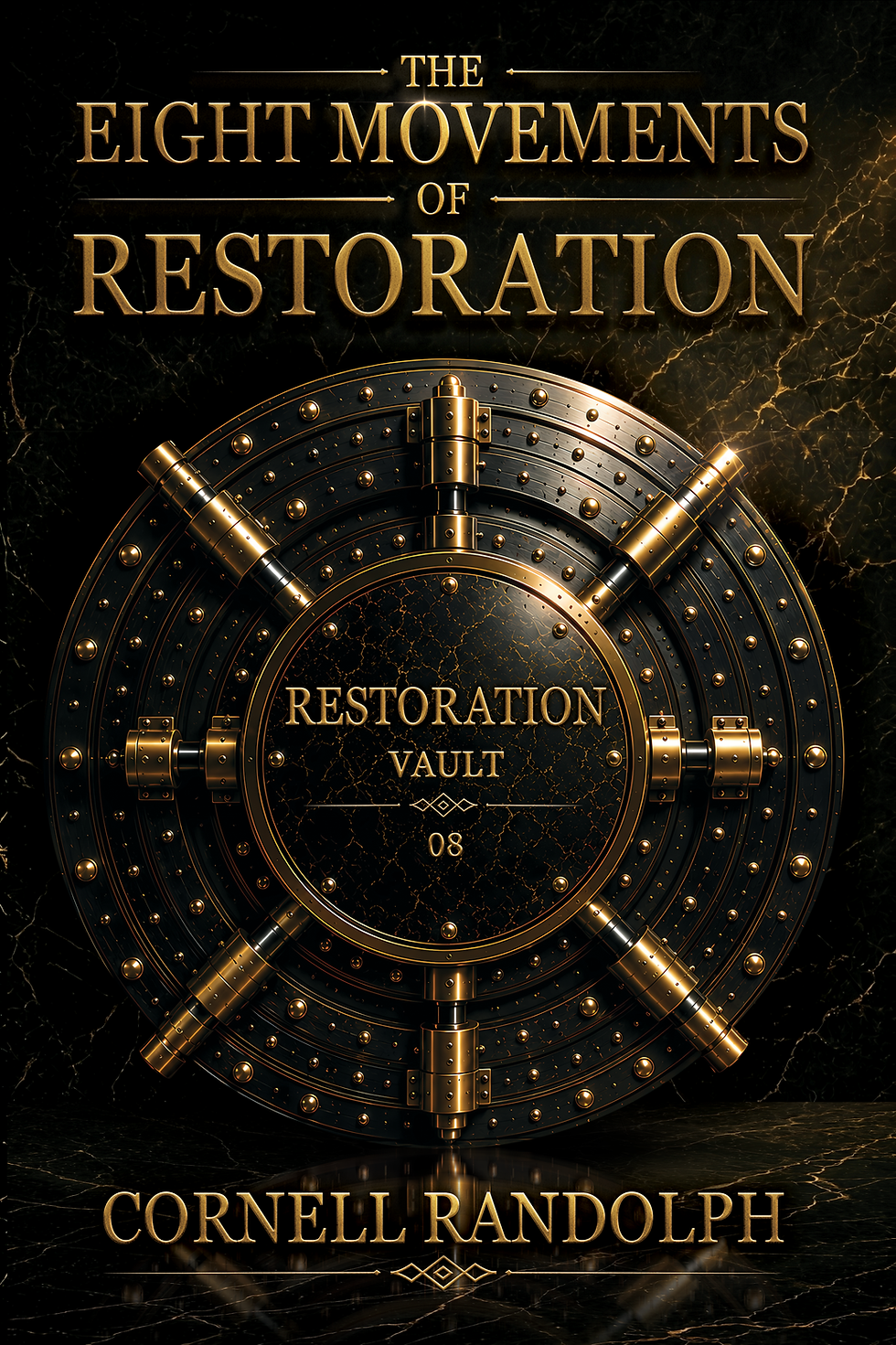
The Eight Movements of Restoration
THE EIGHT MOVEMENTS OF RESTORATION
A Spiritual Blueprint for Rebuilding the Man Within
Read. Research. Reckon. Remove. Repent. Restore. Resist. Redeem.
Restoration begins when a man becomes willing to confront what is broken, discover what is missing, and allow God to rebuild him from the inside out.
Every man carries something within him that needs attention. For some, it is the pain of abandonment, rejection, or a missing father. For others, it is failure, betrayal, addiction, disappointment, trauma, shame, or the consequences of their own decisions. Many men learn how to function while carrying wounds they have never fully confronted.
They become skilled at surviving while remaining broken within.
The eight movements provide a pathway back toward that alignment.
Eventually, survival stops being enough.
He begins longing for something deeper: peace instead of pressure, clarity instead of confusion, integrity instead of hidden compromise, purpose instead of merely existing, and wholeness instead of simply appearing whole.
That awakening is where restoration begins.
A SPIRITUAL BLUEPRINT
The Eight Movements of Restoration is part of Cornell E. Randolph's larger Living Restored vision.
Where The Total Man focuses on building internal moral character and integrity, and Left Adrift and Alone confronts the experiences that can shape a man's identity and understanding of himself, The Eight Movements of Restoration provides a spiritual framework for what comes next.
In his pursuit to understand the true nature of moral character, Cornell E. Randolph discovered a spiritual framework that repeatedly appeared throughout the process of transformation.
Through Scripture, prayer, reflection, discipleship, and life experience, eight distinct movements emerged:
Read. Research. Reckon. Remove. Repent. Restore. Resist. Redeem.
These movements became more than concepts. They became a blueprint for rebuilding a man from the inside out.
The process is much like opening a combination lock. Each movement has a purpose, and the sequence matters. Skip a movement, refuse to confront one, or attempt to move forward without addressing what is behind you, and the lock remains closed.
But when the movements are intentionally embraced, something begins to open.
The man begins to see, he begins to understand, he begins to confront, and he begins to change.
This is the journey from brokenness to wholeness.
THE EIGHT MOVEMENTS
1. READ
Transformation begins with truth.
A man cannot rebuild his life without exposing himself to the wisdom, instruction, and revelation of God. Scripture becomes the mirror that reveals both identity and brokenness.
Read is more than gathering information. It is opening the heart to divine instruction and allowing God's truth to challenge deception, reveal identity, and illuminate the path toward healing.
2. RESEARCH
Truth requires understanding.
Once truth is encountered, a man must begin examining his life honestly.
Why do I behave this way?
Why do I respond this way?
Where did this fear come from?
What wounds are influencing my decisions?
What beliefs have shaped the way I see myself and others?
Research is the pursuit of understanding. It requires reflection, humility, and the courage to look beneath outward behavior to discover the roots underneath it.
3. RECKON
Truth eventually demands a response.
Reckoning is the moment of confrontation.
A man must stand face to face with truth without excuses, blame, or denial. He must acknowledge not only what happened to him but also what he has done to others.
Pride, anger, selfishness, bitterness, lust, fear, unforgiveness, and destructive patterns cannot remain hidden if restoration is going to occur.
Reckoning is where illusion dies and accountability begins.
4. REMOVE
What is destroying you cannot be allowed to remain.
Once destructive patterns are identified, they must be uprooted.
Toxic relationships, destructive thinking, addictions, pride, unforgiveness, unhealthy environments, false identities, and spiritual compromise may have to be removed.
Removal can be painful because it often requires releasing what has become familiar.
But God cannot rebuild what a man refuses to release.
Removal creates room for restoration.
5. REPENT
Repentance is the turning of the heart back toward God.
Repentance is more than regret. It is surrender and realignment.
It is the decision to turn away from what has been destroying the soul and turn back toward truth, righteousness, and God's purpose.
Repentance breaks destructive cycles and becomes more than a single emotional moment. It becomes a lifelong posture of humility before God.
6. RESTORE
God rebuilds what has been damaged.
Restoration is where rebuilding begins.
God restores identity, character, relationships, peace, confidence, and purpose. He can rebuild strength where weakness existed, clarity where confusion once ruled, and hope where despair once lived.
Restoration is not cosmetic change.
It is inner reconstruction.
7. RESIST
What God restores must be protected.
Every restored man will face opposition.
Old temptations return. Familiar voices call him backward. Old patterns attempt to regain control.
Resistance is the discipline of guarding what God has rebuilt.
It requires spiritual strength to stand against compromise, distraction, deception, temptation, and the pull of the old life.
Restoration must be protected if transformation is going to endure.
8. REDEEM
God can give purpose to what once seemed wasted.
Redemption is where God transforms wounds, failures, regrets, and painful chapters into something purposeful.
What once produced shame can produce wisdom.
What once represented bondage can become testimony.
Pain can become compassion.
Brokenness can become ministry.
A redeemed man no longer sees his story as wasted. He begins to see evidence of God's power to restore and transform.
Nothing surrendered to God is ever wasted.
This is the journey from brokenness to wholeness.

Living Restored
LIVING RESTORED
The Destination
What does it mean to live after restoration has begun? It is one thing to confront your past, another to understand your wounds, and even another to experience restoration. But eventually, restoration must become more than something we talk about or experience. It must become the way we live. Living Restored is the culmination of a journey that begins with understanding who we are, confronting what has shaped us, learning how restoration takes place, and ultimately discovering how to live from a restored place. Restoration is not simply about going back and repairing what was broken. It is about moving forward differently. It is about becoming intentional about how we think, how we live, how we relate to others, how we make decisions, how we handle responsibility, and how we walk in the purpose God has placed within us.
Many people spend their lives defined by what happened to them. Some carry abandonment, rejection, shame, failure, or disappointment. Others carry wounds they cannot fully explain but know have influenced the way they live. But restoration teaches us that our wounds may be part of our story without becoming the definition of our lives. What happened to us matters, but it does not have to determine who we become. Living restored means learning how to move beyond simply understanding the wound and beginning to build a life that is no longer governed by it.
Restoration is not a finish line where every struggle disappears. It is an ongoing process of choosing truth over deception, responsibility over blame, purpose over distraction, and growth over remaining comfortable. A restored life requires continued awareness, boundaries, accountability, integrity, faith, and the courage to recognize when old patterns attempt to return. It requires the wisdom to choose differently. Living restored means protecting what God has rebuilt while continuing to become the person He designed you to be.
Knowledge alone does not transform a life. We can understand our wounds and still repeat the same patterns. We can recognize our mistakes and still refuse to change. We can experience healing and still return to the environments and behaviors that once damaged us. At some point, what we know must become what we practice. Living Restored is about turning restoration into a lifestyle. It asks important questions: Who am I now? How should I live differently? What does a restored life look like in my relationships? How do I protect what God has rebuilt? How do I use my story to help someone else? How do I walk in purpose without returning to the person I used to be? These questions move restoration from theory into everyday life.
Living restored does not mean living without challenges. It means challenges no longer have the same authority over you. It does not mean you never experience pain. It means pain no longer gets to define your identity. It does not mean you never forget your past. It means your past no longer controls your future. It does not mean you never struggle. It means you have developed the awareness, character, faith, and responsibility to respond differently when you do. A restored person learns to live from what has been rebuilt rather than continually returning to what was broken.
Living Restored completes the four-book journey. The Total Man begins with character, challenging us to build integrity of character from the inside out. Left Adrift and Alone turns toward story, confronting the experiences, absence, and wounds that helped shape who we became. The Eight Movements of Restoration provides the process, revealing a spiritual blueprint for moving from wounded to restored through eight movements: Read, Research, Reckon, Remove, Repent, Restore, Resist, and Redeem. Then comes Living Restored. The destination is not simply knowing who you are. It is not simply understanding what happened to you. It is not simply experiencing restoration. The destination is learning how to live from a restored place.
To live restored is to stop allowing yesterday to dictate tomorrow. It is to walk with greater awareness, responsibility, integrity, purpose, and faith. It is to understand that restoration gives us more than a repaired past. It gives us an opportunity to build a different future. The restored life becomes a testimony that wounds do not have to become identities, failures do not have to become destinies, and broken beginnings do not require broken endings. Your story can become wisdom. Your pain can become compassion. Your failures can become lessons. Your restoration can become a testimony. And your life can become evidence that transformation is possible.
Four Books. One Journey. One Destination: Living Restored.